
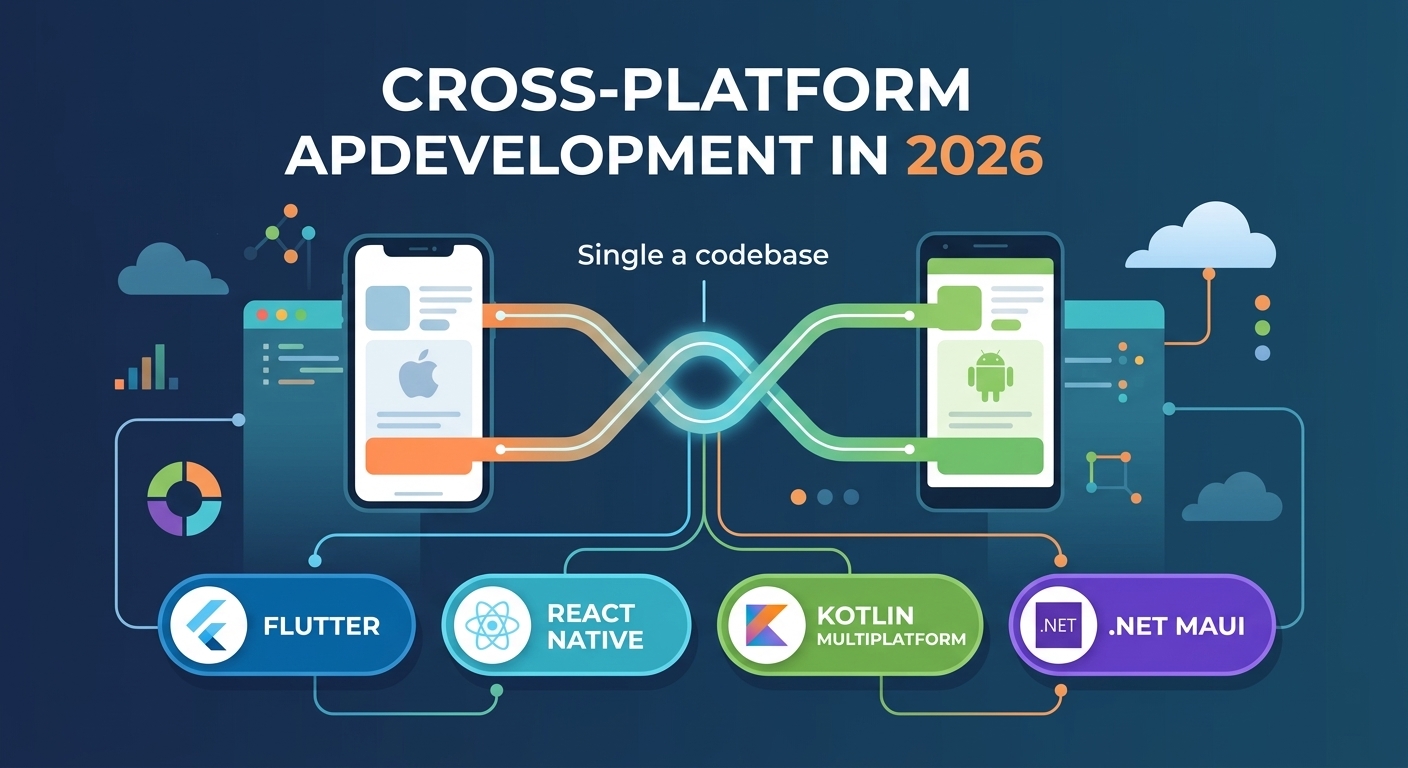
Imagine spending months building an iOS app, only to realize you have to rebuild the entire app again on Android. You didn’t expect this, right? Thankfully, those days are way behind now. A market-ready mobile application with lower development costs gives a rapid approach for both iOS and Android platforms. This is the reason why cross-platform app development has become a go-to choice for new businesses. But here, the biggest confusion comes up: “Which framework deserves your investment?” Modern frameworks are available to help developers scale easily, such as Flutter, React Native, Kotlin, and .NET MAUI. You can use any, but keep in mind the right choice ultimately depends on your app's complexity, performance requirements, scalability, and budget. So what’s next? This blog will run you through a detailed exploration of what platform to choose for cross-platform app development in 2026. First, let’s discuss what cross-platform app development is.
What is Cross-Platform App Development?
Cross-Platform app Development, which we often call multi-platform development too, is a technique in which a team develops its applications across multiple platforms using a single codebase. Developers don't have to write two entirely different native apps, but code can be shared between platforms. The main purpose of this development is to require less effort and to speed up application delivery using modern frameworks. The advantages of cross-platform app development are:
- Faster development cycles
- Lower development costs
- Easier maintenance
- Simultaneous updates for both platforms
- Faster time to market
These advantages are important for many companies to understand the difference between development over six months and over one year. Here’s the quick comparison table of frameworks for cross-platform app development:
| Framework | Language | Benefit |
|---|---|---|
| Kotlin Multiplatform | Kotlin | Good for complex mobile applications requiring native UI |
| React Native | JavaScript, TypeScript | Ideal for teams with JavaScript expertise |
| Flutter | Dart | Best for high-performance apps with custom, branded UIs |
| NET MAUI | C#, XAML | Enterprise choice for Microsoft ecosystem teams |
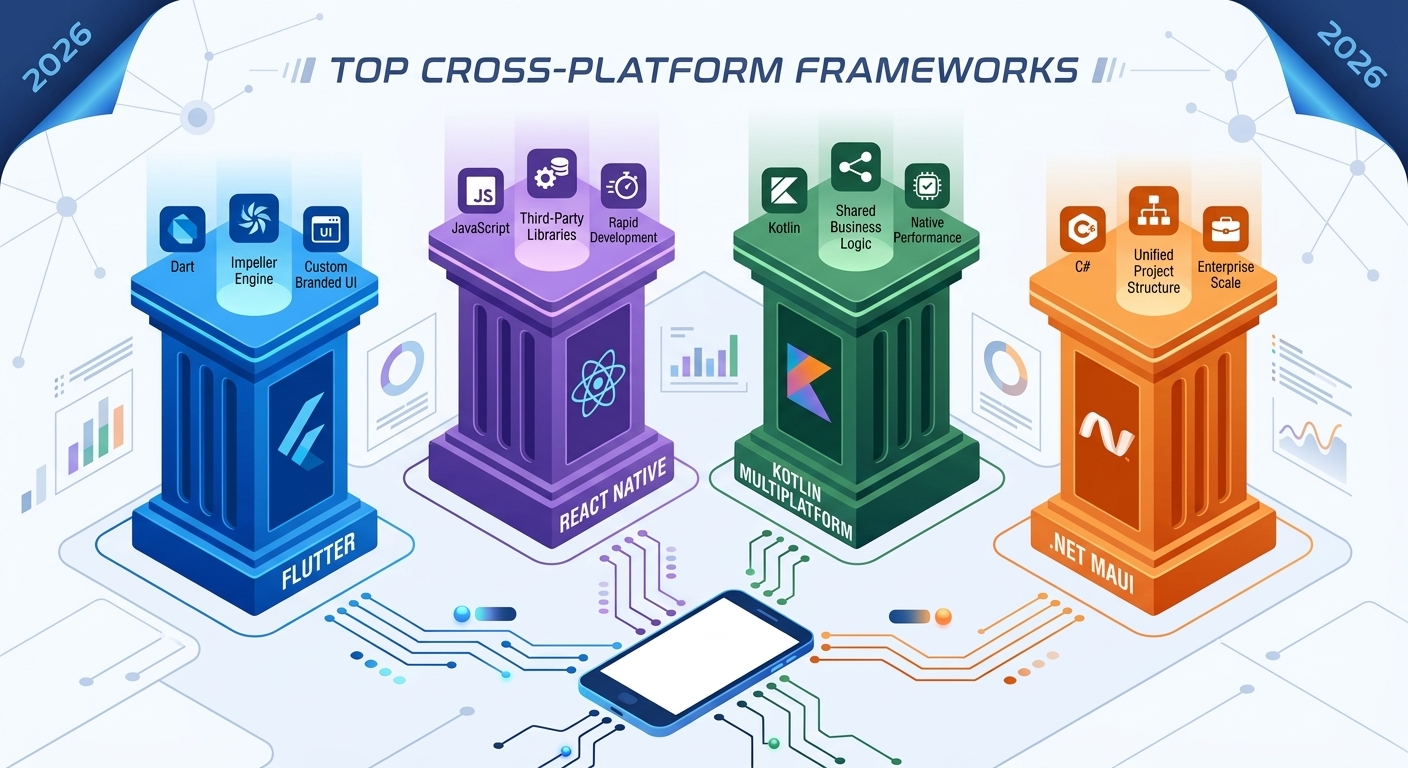
It doesn't matter what industry you're in, or what the development team prefers to use. We can suggest four reliable frameworks for Flutter app development agency and other cross-platform projects:
- Flutter is the most appropriate option if you need your application to be well-designed and customized.
- React Native will work perfectly for you if your team already uses JavaScript.
- If your application should have native-level performance and is quite complicated, Kotlin Multiplatform will be your solution.
- And if you work with the Microsoft ecosystem, .NET MAUI will be just perfect for you.
There is no universal technology that can fit any project. So the best framework is one that fits your goals and requirements.
Top Cross-Platform App Development Frameworks
Flutter
Want custom animations? No worries. Want an interface for all devices? Flutter takes that mission. The Flutter framework is at the top when it comes to cross-platform app development for iOS and Android. It is designed and developed by Google. So no head spins about security, integration, and flexibility. This framework uses the Dart language and has its own rendering engine. Moreover, it controls the UI layer itself to deliver excellent performance on both platforms. Common examples of the Flutter framework are MVPs, prototypes, enterprise mobile apps with high-quality graphics, and applications that require branding for both iOS and Android.
Benefits of Flutter
- With UI consistency and excellent performance, Flutter has a rendering engine that gives smooth animations.
- The strong backing from Google supports integrations, security, and reliability.
- Flutter is a versatile framework that shares a single codebase for all platforms.
React Native
The strong contender, React Native, is a popular framework developed by Meta. React Native app development for businesses provides strong support for web-savvy teams. It uses languages such as JavaScript and TypeScript to build high-quality, smooth mobile applications. With this framework, you can follow a single-codebase approach across multiple platforms. It is different from Flutter as it renders platform-native UI components. To communicate with native elements, React Native uses a JavaScript bridge. E-commerce, social media applications, and MVPs are some ideal examples of the React Native framework.
Benefits of React Native
- React Native supports a large collection of third-party libraries that facilitate rapid development.
- It allows developers to make instant fixes for users.
- Web developers are more familiar with the React Native framework.
Kotlin Multiplatform
Today, Kotlin Multiplatform is used as the latest framework for cross-platform app development. The core value of this framework is that it shares business logic, such as data, across iOS and Android with a fully native UI. It is flexible and allows developers to share anything. You will get true native performance with the KMP framework. Not just iOS and Android, KMP shares it across the web and desktop to offer a seamless solution. According to an analysis by TouchLab published on JetBrains, developers using KMP for mobile app development face 40% to 60% fewer bugs. Common examples of KMP include complex enterprise applications needing native performance.
Benefits of Kotlin Multiplatform
- Kotlin is a modern framework and is flexible for developers.
- It is safe, secure, and strong, as supported by Google for Android.
- Share only business logic or both logic and UI with Compose Multiplatform.
NET MAUI
Designed and developed by Microsoft, the .NET MAUI framework works for different developer communities. It uses C# and XAML language for cross-platform app development. This framework builds native apps for iOS, Android, macOS, and Windows from a single codebase. The NET MAUI framework is used for large applications for enterprises and companies with .NET talent. It also modernizes Xamarin apps by converting multiple codebases into a single codebase.
Benefits of NET MAUI
- NET MAUI simplifies the mobile app deployment process.
- It provides native API access to features.
Benefits of Cross-Platform App Development For Businesses
Unlike hybrid app development services, cross-platform app development isn’t just about technical aspects; it offers many business advantages. It allows a single codebase to be shared across multiple platforms, which helps to reduce the cost, development time, and maintenance. Here are the benefits of cross-platform app development:
Reusable Code
One of the most important benefits of cross-platform app development is the ability to use a single codebase across different platforms. Developers don’t have to rewrite the code for another platform. Rather, they can deploy one codebase for iOS and Android apps. As a result, it saves time for repetitive tasks, such as integrations, data storage, and analytics.
Time Saving
As the application logic and codebase are shared on both iOS and Android, developers can save time by eliminating duplicate functionality. It also helps developers to build new features for both platforms at the same time.
Quicker Time to Market
As there is no need to develop different apps for iOS and Android, you can market your product much faster. And one more thing: if there is any change in the mobile application, the developers can easily make small changes to the code. This will help to get better user feedback.
Final Statement
Before cross-platform app development, creating an application for two operating systems, i.e., iPhone and Android, could be a hassle for many businesses. This issue is no longer today, thanks to cross-platform app development. Today, you will be able to use some reliable frameworks for launching applications simultaneously on both mobile OS without spending double the resources. Do you know what framework to choose? Contact The Design Log, and we will help you develop a scalable and cost-effective mobile application.